We focus on integrating quantum communication, computation, and sensing technologies into 6G networks, analysing their potential quantum advantage for achieving 6G performance goals. Our solutions aim to improve resilience, trustworthiness, and scalability while reducing latency.
Q-TREX, QD-CAMNETZ, and QUIET
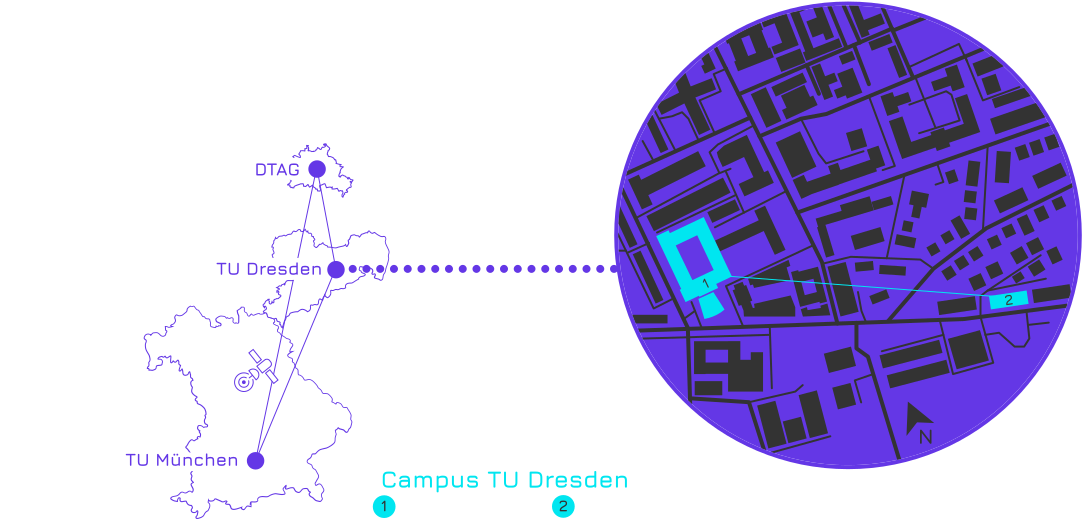
One of our central projects is the development of a 5G campus network, which is being expanded to include quantum technology. This gives companies the opportunity to try out innovative applications in a real test environment.
Q-TREX Resilience for the Quantum Internet
Q-TREX and QUARKS address the same 6G challenge from complementary angles.
As future communication systems evolve into a “network of networks”, 6G and edge computing will have to support cyber-physical services such as digital twins, telepresence, robotics, and tactile interaction under strict constraints on latency, availability, and trust.
Q-TREX (“Resilience for the Quantum Internet”) contributes to the networking foundation by integrating quantum communication into future 6G and existing fixed networks and by developing an end-to-end resilience concept validated in a Berlin–Dresden–Munich test field across the deployment-grade dimensions of security, availability, and reliability. Building on this substrate, QUARKS focuses on how quantum resources can be integrated into 6G systems as usable services, including operating quantum processors as networked edge resources (QPU-as-a-service) and progressing toward in-network/distributed quantum computing, where robust control channels, key management, and entanglement-enabled primitives must remain dependable even under failures, congestion, and targeted attacks.
QD-CAMNETZ
Within QUARKS, QD-CamNetz acts as the concrete engineering testbed that turns “quantum for 6G” from a concept into something measurable in a real network.
QUARKS’ research program explicitly builds a 5G campus network that is expanded with quantum technology, and QD-CamNetz is one of the central projects enabling this step.
In QD-CamNetz, quantum technologies are seamlessly integrated into an operational 5G campus network to target resilience and precise time synchronization, and the project develops quantum routers compatible with existing communication infrastructure, together with a quantum protocol stack and a matching network architecture that can be deployed beyond laboratory conditions for industrial use cases.
This complements QUARKS by providing the environment to evaluate – under realistic constraints – how quantum communication primitives (e.g., secure keying and synchronization) can raise 6G-relevant KPIs, and it provides a credible path toward integrating network-accessible quantum computing at the edge (QPU-as-a-service) and, later, in-network/distributed quantum computing, where dependable networking and timing become enabling services rather than optional features.
QUIET—Distribiuted quantum-IoT metrology network
Within QUARKS “Wide Area Quantum Network” research line, QUIET complements projects like Q-TREX and QD-CamNetz by addressing the IoT/sensing side of quantum-enabled networks.
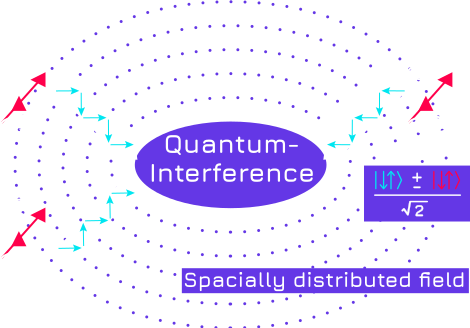
It develops a hybrid quantum–classical communication network in which distributed quantum states are combined with classical transmission to network (quantum) sensors, while explicitly covering all layers from the physical layer to network protocols and working with telecom partners via the “Quantum Communication Innovation Hub.”
In QUARKS, this matters because integrating quantum technologies into future 6G/edge systems is not only about running a quantum algorithm; it requires a deployable, standards-compatible network substrate where security, performance, and protocol behavior are engineered end-to-end.
The same hybrid substrate that QUIET develops for quantum-IoT (secure keying, robust control signaling, and operational cross-layer design) also becomes a prerequisite for operating networked quantum processors at the edge (QPU-as-a-service) and, longer term, for in-network/distributed quantum computing, where inter-node operations depend on dependable classical orchestration together with distributed quantum correlations.
Mobile Edge Quantum Computing and In-Network Quantum Computing for 6G
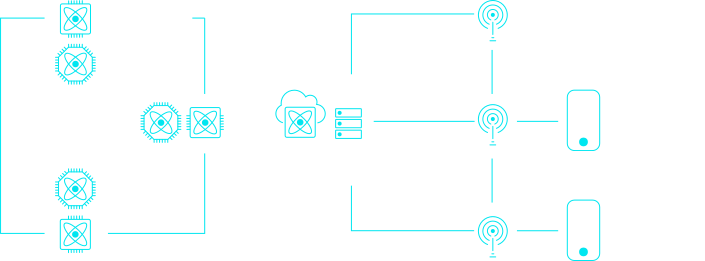
Mobile Edge Quantum Computing (MEQC) treats a quantum processor (QPU) as a networked accelerator deployed within the MEC layer, i.e., close to the radio access network where ultra-low latency, high bandwidth, and real-time RAN context can be exploited by applications and orchestration logic.
In the 6G vision, this placement matters because 6G is expected to rely on distributed intelligence including at the edge and to treat system constraints (latency, reliability, and sustainability) as design drivers, so computing and networking must be engineered together rather than optimized in isolation. Distributed quantum computing (DQC) extends MEQC by coordinating multiple QPUs as a single logical compute fabric, partitioning workloads across nodes and managing inter-node dependencies through classical control and, where available, quantum correlations.
In-network quantum computing pushes this further by making the network itself part of the computer: routing, scheduling, and control of quantum resources (including entanglement distribution and its quality) become first-class system functions instead of “just connectivity.”
In QUARKS, these concepts are pursued as a systems research agenda that integrates quantum communication, computation, and sensing into 6G networks and evaluates whether quantum resources improve 6G-relevant KPIs such as resilience/trustworthiness/scalability and latency.
Concretely, the QUARKS Quantum Edge Computing Lab provides a testbed with three interconnected quantum computers to study hybrid edge workflows under realistic constraints (queueing, calibration validity, end-to-end latency, and service availability), because any “quantum advantage” claim in 6G is only meaningful when assessed at the end-to-end service level, not at isolated device metrics.
Sources
As we are aiming to design a training program that fits exactly your need for knowledge on quantum topics, we are currently surveying precisely this need in a short survey.
Vignesh Raman; Riccardo Bassoli; Frank H. P. Fitzek
When Does Coherent Quantum Closure Phase Help? A Cross-Layer DQC Benchmark for HEP Telescope Networks Proceedings Article
In: IEEE International Conference on Quantum Computing and Engineering (QCE26), IEEE Quantum Week 2026, Toronto, Ontario, Canada, 2026.
@inproceedings{Raman2026hepdqc,
title = {When Does Coherent Quantum Closure Phase Help? A Cross-Layer DQC Benchmark for HEP Telescope Networks},
author = {Vignesh Raman and Riccardo Bassoli and Frank H. P. Fitzek},
year = {2026},
date = {2026-09-13},
urldate = {2026-09-01},
booktitle = {IEEE International Conference on Quantum Computing and Engineering
(QCE26), IEEE Quantum Week 2026},
address = {Toronto, Ontario, Canada},
keywords = {},
pubstate = {published},
tppubtype = {inproceedings}
}

Vignesh Raman; Sakineh Ghaderi; Riccardo Bassoli; Frank H. P. Fitzek
On The Limitations of Distributed Quantum Computing for Future Communication Networks Proceedings Article
In: IEEE International Conference on Quantum Computing and Engineering (QCE26), IEEE Quantum Week 2026, Toronto, Ontario, Canada, 2026.
@inproceedings{Raman2026limdqc,
title = {On The Limitations of Distributed Quantum Computing for Future Communication Networks},
author = {Vignesh Raman and Sakineh Ghaderi and Riccardo Bassoli and Frank H. P. Fitzek},
year = {2026},
date = {2026-09-13},
urldate = {2026-09-01},
booktitle = {IEEE International Conference on Quantum Computing and Engineering
(QCE26), IEEE Quantum Week 2026},
address = {Toronto, Ontario, Canada},
keywords = {},
pubstate = {published},
tppubtype = {inproceedings}
}

Sakineh Ghaderi; Vignesh Raman; Riccardo Bassoli; Frank H. P. Fitzek
When Can Passive Link Metrics Certify a Distributed Quantum Circuit? An Identifiability Analysis Proceedings Article
In: IEEE International Conference on Quantum Computing and Engineering (QCE26), IEEE Quantum Week 2026, Toronto, Ontario, Canada, 2026.
@inproceedings{Ghad2609:DQC,
title = {When Can Passive Link Metrics Certify a Distributed Quantum Circuit? An Identifiability Analysis},
author = {Sakineh Ghaderi and Vignesh Raman and Riccardo Bassoli and Frank H. P. Fitzek},
year = {2026},
date = {2026-09-13},
urldate = {2026-09-13},
booktitle = {IEEE International Conference on Quantum Computing and Engineering
(QCE26), IEEE Quantum Week 2026},
address = {Toronto, Ontario, Canada},
keywords = {},
pubstate = {published},
tppubtype = {inproceedings}
}

Sakineh Ghaderi; Abdelkrim Menina; Leon Röscher; Talía L. M. Lezama; Riccardo Bassoli; Frank H. P. Fitzek
Scheduling Under Stochastic Control Drift in a Room-Temperature NV-Center Quantum Processor Proceedings Article
In: IEEE International Conference on Quantum Computing and Engineering (QCE26), IEEE Quantum Week 2026, Toronto, Ontario, Canada, 2026.
@inproceedings{Ghad2609:Scheduling,
title = {Scheduling Under Stochastic Control Drift in a Room-Temperature NV-Center Quantum Processor},
author = {Sakineh Ghaderi and Abdelkrim Menina and Leon Röscher and Talía L. M. Lezama and Riccardo Bassoli and Frank H. P. Fitzek},
year = {2026},
date = {2026-09-13},
urldate = {2026-09-01},
booktitle = {IEEE International Conference on Quantum Computing and Engineering (QCE26), IEEE Quantum Week 2026},
address = {Toronto, Ontario, Canada},
keywords = {},
pubstate = {published},
tppubtype = {inproceedings}
}
Hilal Sultan Duranoglu Tunc; Joy Halder; Azita Hajizade; Andreas Voigt; Bassem Arar; Riccardo Bassoli; Gerhard P. Fettweis; Frank H. P. Fitzek
Coherence and fidelity aware routing in quantum networks Journal Article
In: Scientific Reports, 2026, (to be published).
@article{tunc2026coherence,
title = {Coherence and fidelity aware routing in quantum networks},
author = {Hilal Sultan Duranoglu Tunc and Joy Halder and Azita Hajizade and Andreas Voigt and Bassem Arar and Riccardo Bassoli and Gerhard P. Fettweis and Frank H. P. Fitzek},
doi = {10.1038/s41598-026-65444-1},
year = {2026},
date = {2026-08-01},
urldate = {2026-08-01},
journal = {Scientific Reports},
publisher = {Nature},
note = {to be published},
keywords = {},
pubstate = {published},
tppubtype = {article}
}
An short overview of quantum terms and explanations
Discover the key terms in quantum communication and computing, along with their respective areas of application.
We offer various educational and cooperation formats that impart knowledge and promote exchange between science and industry.
.
.
Riccardo Bassoli