

Quantum Wiki
The world of quantum physics is full of fascinating phenomena—from superposition and entanglement to entanglement and wave-particle duality.
This wiki provides explanations of key concepts, terms, and technical expressions from the world of quantum physics.
Quantum Terms
Communication
Communication
The term communication comes from the Latin communicatio, meaning “sharing” or “making common.” Communication describes the process of exchanging information between people, animals, machines, or even cells
Measurement of a Quantum System
Measurement of a Quantum System
A measurement is a decisive step in quantum physics because it is how we extract information from a quantum system. In practice, the system interacts with a measuring device, which produces an outcome, a “readout”.
For a two-level system, like a qubit, a measurement in a chosen basis typically yields one of two outcomes, often labeled 0 or 1. More generally, quantum measurements can have more than two outcomes, depending on what is being measured.
Before measurement, the system can be in a superposition of states. At the moment of measurement, the state is updated to a state consistent with the observed resul, often described, in simple models, as a “projection” onto an eigenstate. After that, the original superposition, and especially the unknown probability amplitudes that defined it, cannot be perfectly recovered from that single measurement.
A helpful analogy is a kaleidoscope: once you turn it, you see a new pattern, but you cannot reconstruct the exact previous pattern just by looking at the new one. Similarly, measurement gives you an outcome, but it does not preserve all information about the prior quantum state.
No-Cloning-Theorem
No-Cloning-Theorem
The no-cloning theorem states that it is impossible to produce an exact copy of an unknown quantum state.
This fundamental property of quantum physics ensures that information in quantum communication systems is particularly secure, because it is not possible to copy quantum information perfectly without disturbance, and eavesdropping typically introduces detectable changes, for example, higher error rates in Quantum Key Distribution.
NV Center
NV Center
An NV center, Nitrogen-Vacancy center, is a special crystal defect in the diamond lattice in which a carbon atom is replaced by a nitrogen atom and at the same time, there is an adjacent vacancy in the crystal. This defect center is one of many known defects in diamond and plays an important role in quantum physics, for example, in quantum computers and sensors.
Superposition
Superposition
Superposition is a central concept in quantum mechanics. It describes how a quantum object, such as an electron, photon, or qubit in a quantum computer, can be described in a combination of states. A qubit can therefore be in a state that is not purely 0 or purely 1. Only when measured does the qubit assume one of the two states (0 or 1), thereby destroying the superposition state in that measurement basis.
A vivid example is a spinning coin. As long as it is in the air, it is not showing a definite side. It only shows one of the two sides when it falls to the ground. The same is true for a quantum particle in superposition. Not a perfect analogy, but it helps build intuition.
This principle enables the enormous power of quantum computers, as they use superposition, interference, and entanglement to solve certain problems more efficiently than classical systems.
The concept became famous through Schrödinger’s cat thought experiment, which illustrates that a system in the quantum realm can exist in multiple states simultaneously as long as it is not measured.
Entanglement
Entanglement
Entanglement is a fascinating phenomenon in quantum physics in which two particles are connected in such a way that their measurement results can be strongly correlated.
This correlation only becomes apparent when a measurement is taken. If one of the two particles–regardless of how far apart they are–shows a certain measurement result, then the result of the other is clearly linked to it. Entanglement does not describe remote influence, but rather a profound statistical dependence that forms an important basis for modern quantum technologies. It does not mean that information is sent instantly.
Entanglement is therefore a connection created by a shared joint quantum state that cannot be described as two independent states. Let’s assume that the two qubits are two coins. When the two qubits are measured, it is as if the two coins were tossed. Without entanglement, the coins show heads or tails independently of each other. If you create a table and repeat the experiment, you will see that all possible outcomes are equally likely. However, if the coins were entangled and you performed the same experiment, you would find that when one coin shows heads, the other also shows heads, and vice versa. The event “coin 1 = heads” and “coin 2 = tails” therefore never occurs. And this is independent of how far apart the coins are from each other.
Important! This is only an analogy. Real entanglement is most clearly demonstrated by comparing results across different measurement settings, e.g., Bell-type tests.
This strong connection is not only an amazing natural phenomenon, but also an important basis for modern technologies such as quantum computers and quantum communication.
Wave-Particle Duality
Wave-Particle Duality
Wave-particle duality describes a central phenomenon in quantum physics: quanta—tiny particles such as light (photons) or electrons—exhibit properties of both particles and waves.
Depending on how they are observed or measured, they sometimes behave like small, point-like particles and sometimes like spreading waves. This seemingly contradictory behavior can only be explained by the laws of quantum mechanics and shows that the world at the smallest level functions very differently from how we experience it in everyday life.
Quantum
Quantum sg. | Quanta pl.
A quantum is the smallest, indivisible unit of a physical quantity—the “minimum package” of nature, so to speak. Energy, light, and many physical quantities (in the right context) do not occur continuously, but in tiny portions called quanta.
A well-known example is the photon, which is considered a quantum of light. In atoms, electron energy levels are quantized—electrons also show wave-like and particle-like behavior. This seemingly contradictory behavior is called wave-particle duality.
Quantum mechanics describes how these smallest units behave with its rules and theories—and thus forms the basis for many modern technologies, from lasers and computer chips to quantum computers.
Quantum Computer
Quantum Computer
A quantum computer does not process information like classical computers with bits, but with qubits, which can occupy multiple states simultaneously. This is not the same as a classical “in-between” value like a dimmer switch–it’s a genuinely quantum state.
Our NV-center-based quantum computers manipulate electron spin states and measure them via their photon statistics. To control these complex processes, quantum computers include components such as signal sources, lasers, and controllers. Thanks to this technology, they can solve highly complex problems much faster for certain specific problems (not for everything), for example, in some simulation, optimization, and sampling tasks. Quantum computing is thus a fundamentally new approach to data processing.
Quantum Computing
Quantum Computing
An innovative computing approach that uses qubits instead of traditional bits. These are based on the principles of quantum mechanics and enable more efficient performance of complex calculations for certain tasks than conventional computers. Quantum computers use effects such as superposition and entanglement to solve tasks that can be extremely hard for classical systems.
Quantum Communication
Quantum Communication
An advanced technology for secure data transmission that uses quantum physics principles such as entanglement and superposition. Protocols such as E91 and BB84 enable the exchange of keys for encrypted communication, with security based on physical laws rather than mathematical assumptions.
Quantum communication can reveal eavesdropping attempts because interception typically alters the measured statistics, for example, increasing the observed error rate. Due to technical challenges in transmitting unstable quantum states, it is currently most relevant in security-critical areas such as public administration, defense, healthcare, and the financial sector. It complements existing encryption methods and represents a future-proof security layer.
Quantum Tunneling
Quantum Tunneling
Quantum tunneling describes a fascinating phenomenon in which a quantum particle, such as an electron, can pass through a barrier even though it does not have enough energy to overcome it in the conventional sense.
This works because quantum particles behave not only as particles but also as waves. This means that they have different probabilities of being in different places at the same time, even on the other side of a seemingly impenetrable barrier–so the probability on the far side can be nonzero.
This principle is not just a theoretical peculiarity, but plays an important role in nature. For example, quantum tunneling enables hydrogen atoms to fuse in nuclear fusion, releasing sunlight.
Qubit—Quantum Bit
Qubit
A qubit is the smallest unit of information in a quantum computer–comparable to the bit in conventional computers. However, while a classical bit can only be 0 or 1, a qubit can be in a superposition of 0 and 1. This special behavior is called superposition.
In a figurative sense, this can be imagined as follows: A classical light bulb is either off (0) or on (1). A qubit, on the other hand, would be like a light bulb that is not forced to be strictly off or on until it is measured. Only through measurement does the qubit assume one of the two states. (This is an analogy, not a literal “half-on” bulb.)
Physically, a qubit can be a quantum particle or a quantum system that naturally has two states. For example, the spin of an electron, the polarization of a photon, or the energy levels of an atom. Quantum information is processed by specifically manipulating and measuring these particles.

Beat the Quantum Randomness
Human vs. Quantum computer
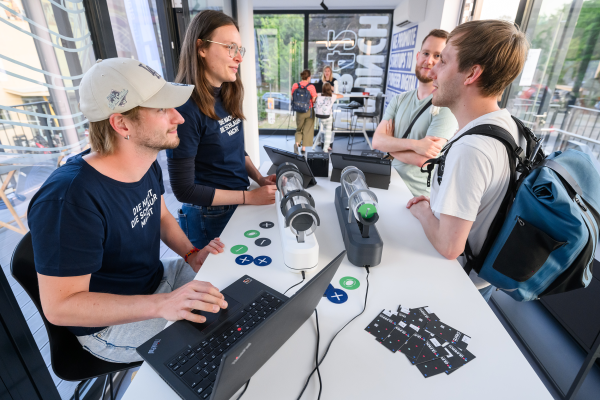
How random can you type a row of fifty 0 and 1? Is your input more random than the output of a quantum computer? Give it a try and learn more about the way a quantum computer works!
Application of Quantum Communication
Random Numbers
Random Numbers
Many modern security systems and websites rely on quantum randomness to generate encryption keys that are truly unpredictable. These genuine random numbers form the basis for even stronger IT security.
Quantum Cryptography
Quantum Cryptography
Quantum cryptography enables secure key exchange based on the physical laws of quantum mechanics—not on an attacker’s computing power. A well-known example is the BB84 protocol. A major advantage is that any attempt at eavesdropping can be detected immediately, guaranteeing the confidentiality of communications.
Tap-proof networks
Tap-proof networks
The development of so-called “quantum internet” structures is laying the foundation for highly secure communication between government agencies, banks, companies, and critical infrastructure. Initial pilot projects in China and Europe are showing promising results. Absolutely tap-proof communication is particularly important in areas such as the military, research, healthcare (e.g., patient data), and even in everyday life.
Satellite Communications
Satellite Communications
Quantum key distribution via satellites is used to bridge large distances where fiber optic connections reach their limits. A well-known example is the Chinese “Micius” satellite, which enables quantum communication between China and Vienna.
Quantum repeaters & networks
Quantum repeaters & networks
Application of Quantum Technology
Medicine
Medicine
Modern imaging technologies such as magnetic resonance imaging (MRI) are based on principles of quantum physics. They use nuclear spin and quantum alignment to generate high-resolution images from inside the body—a fascinating application of quantum mechanics in healthcare.
Big data analysis
Big data analysis
Quantum computers can perform certain computational operations, such as linear algebra or pattern recognition, exponentially faster than classical systems. This opens up a wide range of applications in areas such as image and speech recognition, financial market analysis, and medical diagnostics. Many big data challenges are optimization problems, such as route planning or resource allocation—quantum algorithms could provide innovative solutions here.
Materials research
Materials research
Quantum mechanics is fundamental to understanding materials.
Classical computer simulations often reach their limits because the interactions of many electrons are extremely complex. Quantum computers and special algorithms offer new possibilities: they enable the simulation of new materials, the calculation of electronic structures of molecules and solids, and the development of advanced technologies such as superconductors, battery materials, semiconductors, and topological quantum materials.
Laser technology
Laser technology
Light from LEDs and lasers is produced by electrons jumping between energy states – a process that can only be explained by quantum mechanics. Light from LEDs and lasers is produced by electrons jumping between different energy states – a process that can only be explained by quantum mechanics. These fundamentals enable numerous applications in communication, medicine, and industry.
Quantum Education
SCHOOL MODULE Q1
.



Be part of the quantum future
We offer various educational and cooperation formats that impart knowledge and promote exchange between science and industry.

INDUSTRIAL INNOVATION DAY
.
SCHOOL MODULE Q1
.